

During FCJ’s Q1 meeting on 3 March 2026, attendees heard from Helen Grimberg and Madeleine Kelly, co-founders of Integrity Conflict Solutions, in a Q&A chaired by Seema on the role of mediation and alternative dispute resolution (ADR). The session focused on why FCJ sees ADR as an increasingly important part of a fairer and more proportionate civil justice system, and why earlier intervention can often deliver better outcomes than formal litigation.
Opening the discussion, Seema set out FCJ’s view that there is often an alternative to litigation that offers a faster, more cost-effective and less adversarial route to redress. This includes mediation, ombudsman services and other forms of ADR. She noted that large-scale litigation is often costly, time-intensive, reputationally damaging and operationally disruptive, particularly where multiple claims arise at once. Against that backdrop, the session explored what earlier dispute resolution can achieve in practice.
Helen and Madeleine brought complementary perspectives from their previous careers. Helen reflected on her 30 years as a defence litigator for insurers and corporates, explaining that litigation can too easily become the default route even where early resolution may be possible. Madeleine, speaking from an in-house commercial perspective, described how businesses are usually focused on cost savings, speed, risk management and protecting relationships, and that “litigate at all costs” was rarely the best commercial answer. Both speakers explained that their experience led them to establish Integrity Conflict Solutions to promote earlier intervention and to help parties resolve disputes before positions harden and costs escalate.
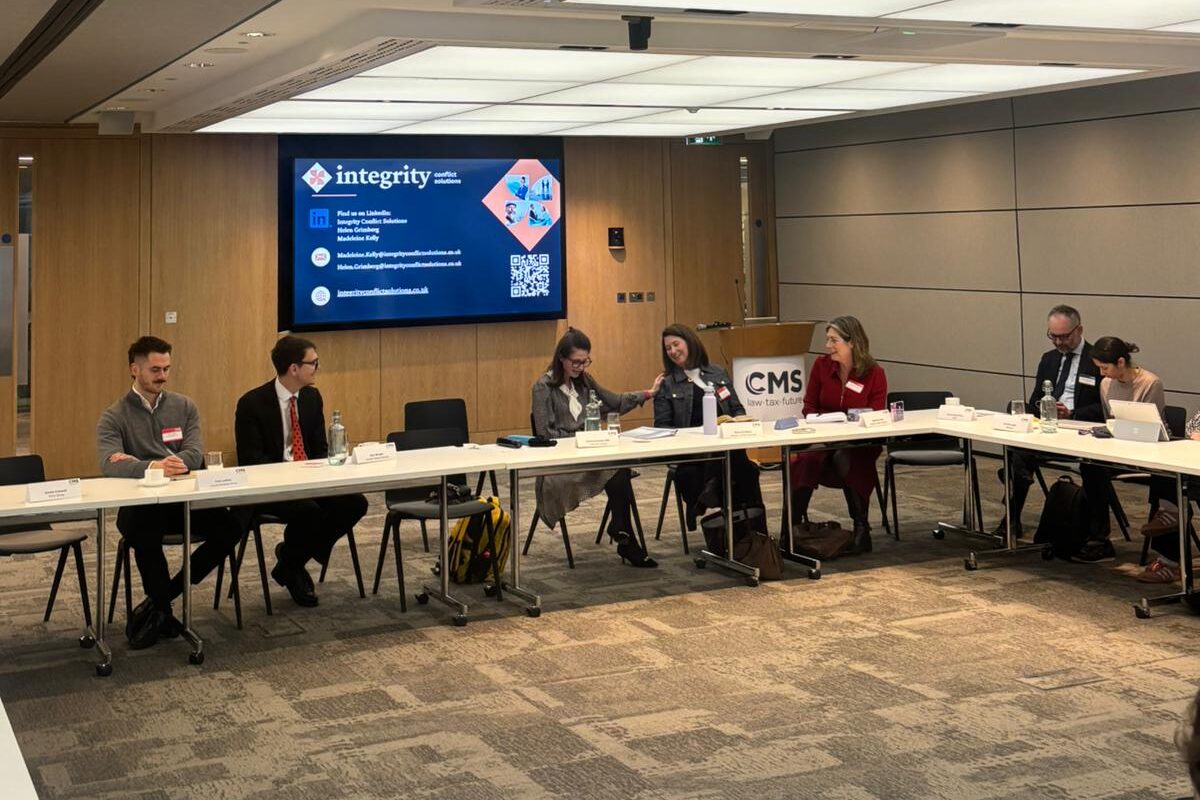
The discussion covered the types of disputes most suited to mediation and ADR. Madeleine explained that, in practice, most commercial disputes are capable of being mediated if the parties are willing to engage. Common examples include supplier and contractor disputes, client or customer disputes, fractious board relationships, and shareholder or partnership issues. She also noted that multi-party disputes can be suitable for ADR, and that there is no reason in principle why group claims cannot be mediated.
A key theme of the conversation was the persistence of misconceptions around mediation. Helen observed that mediation is still often seen as a sign of weakness or a signal that a party lacks confidence in its position. She suggested that the psychology of litigation can make parties feel that issuing proceedings demonstrates strength and decisiveness, whereas mediation can wrongly be viewed as compromise for its own sake. However, the discussion stressed that mediation can be highly effective because it allows parties to retain control of the process, manage financial and legal risk, preserve confidentiality, and protect commercial or personal relationships. Even where mediation does not fully resolve a dispute, it can still narrow issues and reduce the cost and scope of any later litigation.
The speakers also highlighted the growing body of evidence supporting mediation. The session noted that Ministry of Justice research in 2022 found that 2.5 million disputes had been mediated in the UK in recent years. Members also heard that legal fees, management time and lost productivity are estimated to cost UK businesses £5.9 billion a year, while mediation typically costs around 10% of comparable court costs. Additionally, timelines contrast significantly: while the civil justice system can take around 72 weeks to reach a court hearing, mediation can often be arranged in two to four weeks. The session also referenced settlement rates showing that 92% to 70% of cases settle at mediation or shortly afterwards.
Both speakers emphasised that mediation should not be seen as a weak option or merely a stepping stone to litigation. Rather, it is a serious and increasingly established method of dispute resolution, fully endorsed by courts and tribunals, and one that can work in both bilateral and multi-party disputes. Seema closed by underlining that businesses which choose mediation are often better able to control costs, reduce disruption, protect reputation and maintain stakeholder confidence.
The session reinforced an important FCJ priority for 2026. Alongside our wider work on civil justice reform, FCJ will continue to promote ADR, mediation and other faster, fairer alternatives to litigation, and to make the case for a stronger culture of early resolution across the civil justice landscape.